
Washington County Municipal Court Warrants
The name misleads people. A Washington County municipal warrant is a court order tied to a city ordinance, a city ticket, or a missed municipal date, and the issuing happens inside the state court system rather than at a city police department. Hagerstown, Boonsboro, Smithsburg, Williamsport, and Hancock all have police coverage. None runs its own criminal court. That matters because a town notice sends residents hunting for a town office. The trail ends at the District Court of Maryland for Washington County, where non-felony municipal ordinance cases belong. A town can keep its ordinance record. It cannot confirm a warrant, so the court is the place to ask. Anyone holding a town letter should treat it as a pointer, not the answer.
Washington County Cities With Municipal Courts
None of the five largest towns runs a municipal criminal court. Each one has a police contact and a town office, while every court matter moves through the Washington County District Court.
| City | Municipal Court | Warrant Types | Phone |
|---|---|---|---|
| Hagerstown | None. District Court jurisdiction. | Ordinance and city ticket cases | 301-790-3700 |
| Boonsboro | None. District Court jurisdiction. | Town code and ordinance cases | 301-432-6838 |
| Smithsburg | None. District Court jurisdiction. | Town code and ordinance cases | 301-824-3500 |
| Williamsport | No town court. Contracted Sheriff's Office coverage. | Ordinance cases through District Court | 301-223-7711 |
| Hancock | None. District Court jurisdiction. | Town code and ordinance cases | 1-800-792-8501 |
Municipal Ordinance Cases in Washington County
Washington County follows state law on jurisdiction, not local custom. Courts and Judicial Proceedings §4-301 gives the District Court exclusive original jurisdiction over vehicle-law cases, misdemeanors, and non-felony municipal ordinances. No town can build its own criminal court for parking tickets.
The Maryland Courts Washington County District Court directory lists the courthouse address, hours, and jurisdiction.
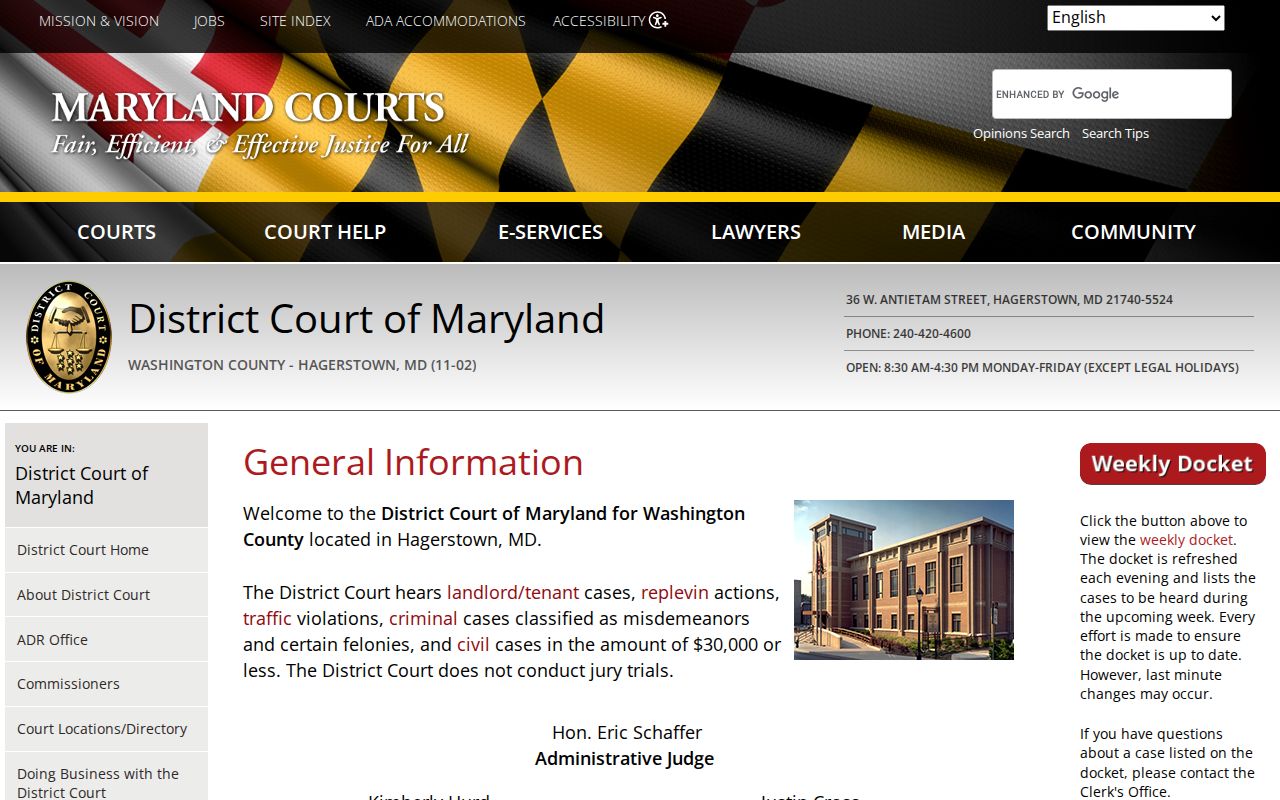
A town does run a civil process for its own tickets. Hagerstown works parking and red-light citations through a city office and a Washington County District Court trial request. That route is a ticket process, not a criminal court.
Key Rules:
Maryland Rule 4-212 governs how a summons or warrant issues on probable cause.
The Maryland Public Information Act gives the public a right to inspect a record, subject to exceptions.
Checking a Washington County Municipal Warrant
No town publishes a warrant lookup. A Washington County municipal check goes through the court and the county unit that already exist, so keep the citation number handy.
- Read the notice for the town, charge, and citation number.
- Call the town police non-emergency line to ask where the matter was filed.
- Search Maryland Case Search with the citation number and the District Court filter for Washington County cases.
- Call the Washington County District Court at 240-420-4600 and ask what the file records.
- Call the Sheriff's Office Warrant Unit at 240-313-2192 or 240-313-2877 for the Washington County self-check procedure.
- File a narrow public information request when a record is not online.
Washington County Sheriff's Office Warrant Unit
500 Western Maryland Parkway, Hagerstown, MD 21740
240-313-2192 or 240-313-2877
District Court of Maryland for Washington County
36 West Antietam Street, Hagerstown, MD 21740
240-420-4600
Why a Town Hall Is Not a Warrant Clerk
Town hall keeps the minutes, the permits, and the ordinance book. It does not keep the warrant docket. Ask a clerk there about a warrant and you will be sent along to the police department or Washington County. The office simply does not hold the record.
The Hancock municipal building shares an address with the town police department, a reminder that one civic building can host several offices with very different records.

A second Washington County myth: a warrant vanishes once a name drops off a public list. A blank result proves nothing. Only the issuing court can recall the process.
Inside a Washington County Municipal Warrant
Once a municipal case reaches the state system, its record looks like any other Washington County lower-court file. Read identity first, then process entries, then the access state.
| Case Number and Court | The route to the clerk and the court that controls the matter. |
|---|---|
| Ordinance or Charge | The town code section or state charge described on the notice. |
| Town or Agency | Which municipality or department issued the citation. |
| Process Type | Citation, criminal summons, bench warrant, or failure-to-appear process. |
| Service and Return | Served, attempted, recalled, or quashed entries as recorded. |
| Access State | Online summary, courthouse file, or restricted material. |
Plain Terms in a Washington County Municipal Case
The paperwork in a Washington County case repeats a small set of words, and each points to a different office.
- Citation
- The ticket that starts a municipal matter, with the number that opens the case record.
- Payable
- A ticket that payment can satisfy instead of an appearance, if the deadline is met.
- Must appear
- A ticket that requires a court date regardless of payment.
- Failure to appear
- Missing a required court date, which can lead a judge to issue a bench warrant.
- Bench warrant
- A judge's order to bring a person before the court for a missed obligation.
What a City Notice Says and Does Not Say
A Washington County town notice names the ordinance, the date and place of the violation, the amount if the ticket is payable, and an instruction to pay or appear. That identifies the case. It does not answer a warrant question. Start with the number on the notice, and if a court date has passed, call the Washington County District Court before assuming the worst. A missed date can lead to a bench warrant. It can also lead to a reset, which is why the court, not the notice, settles the question.
Parking Tickets and Washington County Criminal Cases
A parking ticket and a criminal charge can both start with an officer, yet they end in different places. Hagerstown publishes its parking fines and a contest route through the Parking Office at 25 East Franklin Street, with mailed requests to Public Works at 51 West Memorial Boulevard, and a driver has five days from the due date to request a District Court trial. Smithsburg shows the same boundary from the enforcement side. Its code enforcement page lists town rules such as clearing snow and ice within 24 hours, and those are town code matters, not criminal charges. Williamsport adds a wrinkle because the town has no independent police department. Its emergency services page says police protection comes through a contract with the Washington County Sheriff's Office, a contract that changes who answers the phone but not which court holds the case. City ticket questions follow the traffic warrant search routes.
Resolving a Washington County Municipal Warrant
Fixing a Washington County municipal warrant runs through the court that set the case, even when the ticket came from a town. Expect an appearance, a motion through the clerk or counsel, a payment plan, or a court order recalling the process. The town itself cannot close it.
Caution: paying a ticket does not automatically lift a bench warrant, and a receipt from a payment site is not a court order. Confirm the current status with the District Court and the Warrant Unit before you rely on it.
Ask the clerk what the court needs, and keep the case number in every message. County-wide steps for handling a warrant sit on the Washington County warrant records home page.